In a capital city defined by constant noise, partisan combat, and the unrelenting spin of the 24-hour news cycle, the most heavily analyzed political statement of the week arrived in total silence. During a high-stakes address on Thursday afternoon, President Donald J. Trump brought a packed Washington auditorium to a complete standstill.
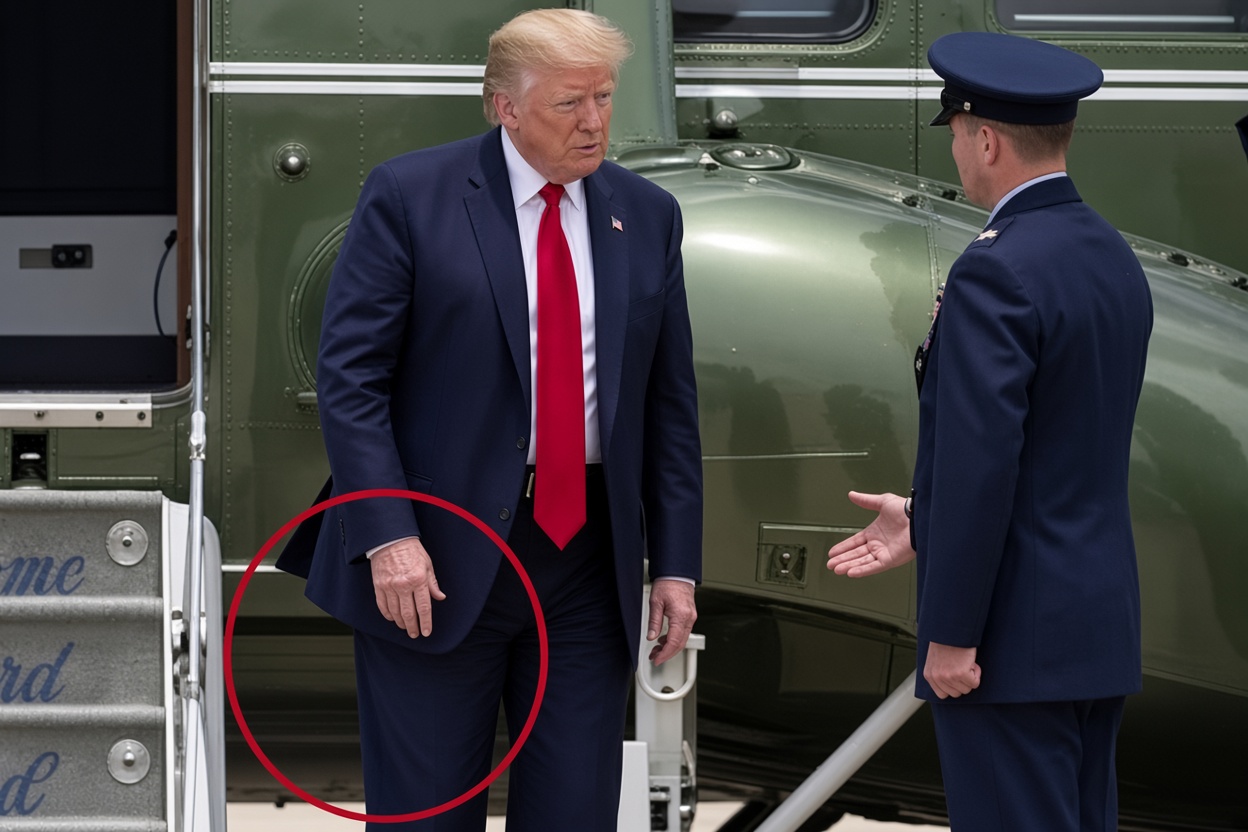
The room was filled with the usual mix of lawmakers, foreign dignitaries, staff, and national press, all expecting the familiar Trump performance: high volume, rapid cadence, and an immediate assault on opponents or a recitation of administration accomplishments. From the start of his political career, Trump’s public style has been defined by velocity and an unwillingness to cede airtime. Yet as he stepped to the lectern, the expected rhythm broke. Instead of launching into speech, he stopped. For several long seconds he said nothing at all. He stood quietly, sweeping a measured, unblinking gaze across the auditorium.
Witnesses described an immediate shift in the room. The ordinary low buzz of a political audience softened into an uneasy hush, broken only by the synchronized click of dozens of camera shutters. In a city where public figures almost never surrender a second of attention, the pause carried unexpected weight. Rather than reading as hesitation, the silence registered as deliberate. Every broadcast camera and every attendee locked onto the man at the podium.
Within minutes of the speech ending, clips isolating the interval spread across X and Truth Social, drawing tens of millions of views in a matter of hours. The moment quickly became a cultural flashpoint, producing sharply divergent readings that mirrored the country’s polarized media environment.
For Trump’s base and many conservative commentators, the pause was received as a display of stoic command. In a period of economic pressure and elevated geopolitical tension, allies described it as the image of a leader absorbing the gravity of the office—a calm contrast to the frantic partisan noise surrounding him. Progressive analysts and political opponents offered a different frame: the stillness was either an ordinary breath in public speaking or calculated theater designed to generate coverage from almost nothing. The fact that a roughly five-second pause could occupy editorial rooms and drive a multi-day cable cycle was itself treated as evidence of Trump’s continuing ability to set the terms of national conversation with minimal output.
Rhetorical specialists and political communicators noted that silence is among the most difficult tools to use effectively. Spoken words invite immediate fact-checking, transcription, and rebuttal; deliberate silence does not. It functions as an open surface onto which audiences project their own expectations, anxieties, and political assumptions. By withholding speech at the outset, Trump required the press corps and the viewing public to wait on his timing rather than the other way around. The technique disrupted the standard rhythm of political coverage and demonstrated an intuitive sense of televisual pacing. In a media environment saturated with continuous sound, an abrupt absence of words proved more disruptive than elevated volume.
The episode also stood in contrast to conventional Washington practice. The standard playbook favors scripted talking points, carefully managed teleprompter delivery, and an institutional aversion to dead air. Politicians are trained to fill every second. Trump’s pause inverted that model. After the interval he moved directly into the core elements of his America First agenda—economic policy, deregulation, and judicial appointments—without acknowledging or explaining the preceding silence. The White House issued no formal statement and offered no defensive clarification, treating the moment as self-explanatory. By leaving the pause unaddressed, the administration allowed media outlets to generate successive layers of speculative analysis, reinforcing a pattern in which much of the political and journalistic apparatus continues to react to the president rather than dictate the frame.
As the news cycle moves on, the brief interval in Washington illustrates a durable feature of contemporary politics: the boundaries between policy substance, personal branding, and visual performance have become porous. Whether the pause originated in momentary reflection, an instinct for dramatic timing, or simply the need to gather thoughts, its effect was singular. In a capital that habitually talks over itself, the president demonstrated that commanding undivided attention can sometimes require saying nothing at all.
The broader implication is straightforward. In an information environment optimized for volume and speed, the capacity to create and control silence retains unusual power. It forces observers to fill the gap, it resists easy rebuttal, and it converts the audience’s own interpretive labor into amplification. For an administration that has long treated media attention as a primary instrument of influence, the five-second pause offered a compact demonstration of that principle in action. The words that followed mattered; the interval that preceded them mattered more.