ROYAL FAMILY SPECIAL REPORT | NOVEMBER 17, 2026 MEGHAN MARKLE • PRINCE HARRY • ROYAL CONTROVERSY
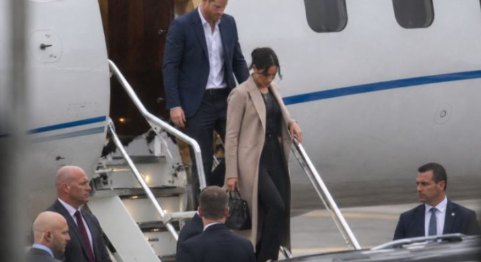
A sensational online claim alleging that Meghan Markle was captured in a tense exchange with a member of her security team has sparked widespread discussion about the Duchess of Sussex’s personal life and professional pressures. According to the circulating account, paparazzi photographed Meghan descending from an aircraft and appearing visibly frustrated as she spoke with her bodyguard. Lip-reading experts, the story suggests, later decoded the reason behind her apparent anger.
The allegation raises intriguing questions about privacy, public scrutiny, and the unique challenges faced by high-profile figures who have stepped away from traditional royal roles. However, the account provides no verifiable evidence—no authenticated footage, no named witnesses, no expert analysis, and no confirmed transcript. Without these elements, the story remains unproven speculation rather than confirmed fact.
Despite the dramatic headline, the claim has renewed interest in Meghan’s security arrangements since the Sussexes’ decision to leave official royal duties in 2020. Yet it also highlights how easily isolated moments can be interpreted as evidence of conflict when context is missing.
THE AIRPORT MOMENT THAT HAS RAISED QUESTIONS
The story describes Meghan stepping off an aircraft and engaging in what observers interpreted as a heated discussion with a security officer on the tarmac. The setting is presented as a typical airport arrival, with the Duchess accompanied by her bodyguard as she moved away from the plane.
Crucially, the account fails to specify the airport, the exact date, or the identity of the bodyguard. It also offers no original photographs, video, or any form of independent verification. These omissions are significant because they prevent any meaningful assessment of the incident.
Even if a fleeting expression of frustration were observed, it would not automatically indicate anger directed at the security officer. A quick glance, a raised voice, or a hurried gesture can stem from any number of unrelated factors—fatigue from travel, logistical concerns, or simply the demands of constant attention. Without surrounding context, such moments are far too ambiguous to support claims of personal conflict.
THE LIP-READING CLAIM AT THE CENTRE OF THE STORY
The most sensational element involves the suggestion that a lip-reading expert examined the footage and uncovered the specific words or reasons for Meghan’s supposed frustration. This detail is designed to add credibility and intrigue, implying a hidden conversation that explains the emotional exchange.
However, the alleged words spoken during the interaction are never identified. No expert’s name is provided, no transcript is offered, and no original recording is made available for review. Lip-reading itself carries inherent limitations: similar mouth movements can convey different phrases depending on speed, accent, lighting, camera angle, and video quality. A single clip may omit crucial preceding dialogue, while poor resolution can render interpretation unreliable.
Without authenticated material and transparent expertise, any proposed transcript remains speculative at best. The absence of these details makes the claim particularly difficult to evaluate and underscores the importance of demanding rigorous verification in sensational royal stories.
WHY MEGHAN’S SECURITY ARRANGEMENTS ATTRACT ATTENTION
Security has been a constant theme in discussions about the Sussexes since they announced their decision to step back from official duties in 2020. Harry has repeatedly spoken about the dangers his family faces, citing specific threats that prompted the couple to relocate from the United Kingdom to California.
The Sussexes’ non-working royal status means their protection falls under different legal and professional frameworks than those afforded to active senior royals. While the Queen provided them with security support during their official duties, the shift to private arrangements has led to ongoing public debate about safety, cost, and responsibility.
This broader context explains why any interaction involving Meghan and her security team draws scrutiny. High-profile travellers often navigate complex logistics—coordinating vehicles, managing crowds, handling photographers, and responding to sudden changes. A hurried conversation with a bodyguard might reflect a last-minute adjustment rather than personal discord. The existence of security concerns does not, however, prove that any specific confrontation occurred on this occasion.
COULD AN AIRPORT ARRIVAL CREATE TENSION?
Airports present unique challenges for any international traveller, and Meghan and Harry are no exception. Even routine flights can involve delays, coordination issues, or unexpected interruptions that require rapid communication.
A security officer might be summoned to discuss vehicle arrangements, crowd management, or a change in schedule. These interactions are practical necessities rather than indicators of conflict. They can be urgent without being hostile, and they occur in environments where discretion and professionalism are essential.
The story offers no evidence of a security failure, dispute, or unexpected incident. Attributing Meghan’s behaviour to a particular motive would therefore be speculative and potentially misleading. The logistical realities of travel are real, but they do not establish personal drama.
THE PAPARAZZI FOOTAGE THAT REMAINS UNVERIFIED
The headline claims photographers captured Meghan’s frustration in real time. Yet no authenticated original footage has been established. A credible investigation would require details about the location, date, source, editing process, and full sequence of events.
A single photograph might show a tense expression without revealing its cause. A short video could omit the conversation immediately before the interaction. Audio-free footage leaves the substance of the exchange completely open to interpretation. When claims centre on someone’s emotional state, these limitations are critical, and they highlight why unsubstantiated stories can quickly spread online without accountability.
MEGHAN’S LIFE UNDER INTENSE PUBLIC SCRUTINY
Meghan Markle has lived under extraordinary media attention since her relationship with Prince Harry became public in 2016. Their wedding in May 2018 drew global viewership, followed by a series of official engagements that ended in 2020.
The couple’s move to the United States marked a deliberate shift toward a private, independent life. They have since focused on family, charity, media projects, and other ventures, deliberately stepping away from royal duties to protect their children’s privacy. Throughout this transition, Meghan’s every public appearance—her clothing, gestures, facial expressions, and interactions—has been examined in detail.
This level of scrutiny can lead to misinterpretation. Ordinary moments, such as a quick exchange at an airport, are sometimes presented as evidence of personal conflict when they may simply reflect the pressures of constant visibility. Extraordinary attention does not justify extraordinary assumptions.
THE BODYGUARD’S ROLE IN THE ALLEGED ENCOUNTER
The account places a security officer at the centre of the supposed confrontation. However, it does not identify the individual, describe their responsibilities, or provide any verified statement from them.
Security personnel operate in demanding environments where rapid, professional communication is vital. A serious discussion between a client and a bodyguard does not necessarily indicate hostility. Without evidence that the officer made an error, became involved in a dispute, or that Meghan blamed him for any issue, the suggestion of blame remains pure speculation.
WHY BODY LANGUAGE CAN BE MISLEADING
Public figures are frequently judged by brief visual moments. A serious expression might be labelled anger, an animated gesture as an argument, or a hurried departure as evidence of crisis. Yet facial expressions and gestures are not reliable substitutes for direct evidence about intentions.
People can appear frustrated, distracted, or uncomfortable for countless reasons unrelated to the people around them. Camera angles can exaggerate intensity, and context is often lost in the rush to judgment. The alleged airport incident serves as a clear example of how limited visual descriptions can be inflated into narratives of personal conflict.
HAS MEGHAN RESPONDED TO THE CLAIM?
The circulating story contains no authenticated response from Meghan Markle or her representatives. There is also no confirmed statement from the security officer allegedly involved. No credible evidence establishes that Meghan acknowledged any disagreement or explained her actions.
It would therefore be inappropriate to invent a reaction or suggest that her silence confirms the allegation. Until reliable information emerges, the supposed confrontation remains unsubstantiated.
THE QUESTION BEHIND THE ROYAL HEADLINE
The story relies on several elements to build suspense: Meghan in a visible setting, her described as unusually angry, a security officer as the apparent target, and a lip-reading expert providing the missing explanation. Yet the explanation is never revealed.
This structure encourages readers to fill in the blanks with drama. The central unanswered question is not what Meghan might have said, but whether the encounter itself ever occurred as described. The real mystery lies in the absence of verification.
FINAL VERDICT: THE AIRPORT MYSTERY REMAINS UNCONFIRMED
The claim suggests that Meghan Markle was photographed confronting a bodyguard after landing and that a lip-reading expert uncovered the cause of her anger. But no authenticated footage has been provided. No credible expert analysis has confirmed any conversation. And there is no reliable evidence of a security-related dispute.
Meghan’s public life and the Sussexes’ security arrangements continue to be legitimate subjects of public interest. However, claims about private confrontations demand careful, evidence-based verification. The real mystery is not what Meghan supposedly said on the airport tarmac. It is whether the alleged exchange was ever captured on camera—and whether the dramatic interpretation attached to it bears any resemblance to reality.
In an age of instant social media circulation, stories without substantiation can quickly shape narratives. The responsibility lies with readers to approach such royal claims with the same rigorous scrutiny applied to any other high-profile allegation. Until verified information surfaces, speculation must remain just that—speculation.